
How Can a Single Analogy Reshape Learning Across a Course?
The role of comparison in retention, transfer, and analysis

Analogies play a central role in learning because they help students connect new ideas to existing mental frameworks. In the humanities, history, and political science, where abstract concepts, unfamiliar contexts, and dense language often dominate instruction, analogies provide an essential bridge between what learners already know and what they are being asked to understand. Their importance lies not in simplifying content into something smaller, but in making complex ideas intelligible, memorable, and usable.
Courses in these disciplines demand more than factual recall. Students must interpret texts, weigh competing perspectives, and reason about systems that operate across time and culture. Analogies support this work by offering conceptual anchors. When a political institution is described as a referee rather than a player, students gain an immediate sense of its function within a broader system. That image organizes subsequent information and gives students a way to evaluate actions and outcomes. Without such anchors, ideas remain isolated and difficult to integrate.
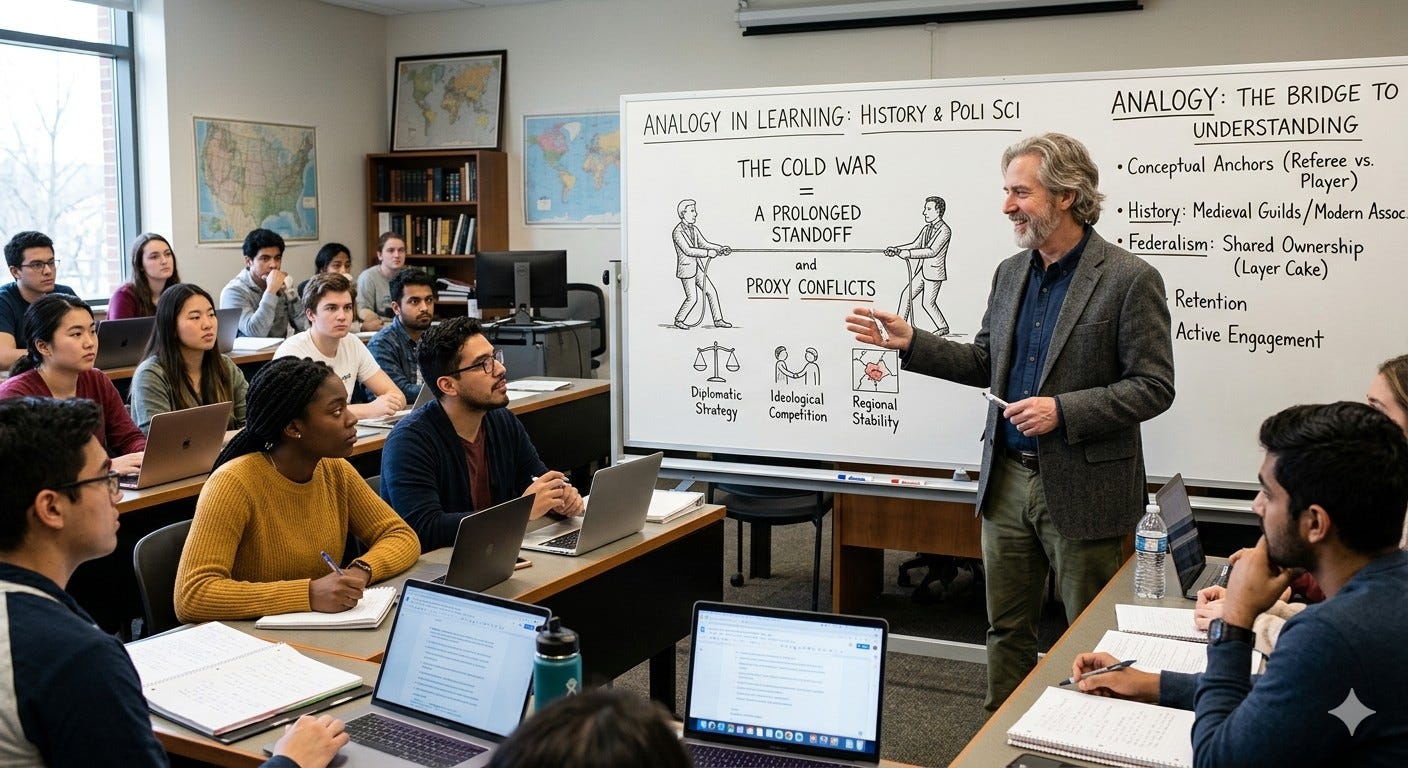
Historical thinking benefits from analogy because the past is fundamentally foreign. Students encounter societies with unfamiliar values, technologies, and assumptions. Analogies allow instructors to relate those worlds to experiences students recognize, while preserving the integrity of historical difference. Comparing medieval guilds to modern professional associations helps students grasp their economic and social roles. The analogy does not collapse the two into sameness. It creates an entry point that invites deeper inquiry into where the comparison holds and where it breaks down. This process strengthens historical reasoning by encouraging careful evaluation rather than surface recognition.
In political science, analogies often shape how students understand power, authority, and legitimacy. Concepts such as federalism, sovereignty, or checks and balances can feel abstract without concrete reference points. Describing federalism as a layered system of shared ownership helps students visualize how authority operates at multiple levels. That image supports later analysis of policy conflicts and jurisdictional disputes. Students who learn through analogy tend to reason more effectively because they can trace relationships rather than memorize definitions.
Analogies also promote retention. Ideas connected through meaningful relationships are easier to recall than lists of disconnected facts. When students remember an analogy, they often remember the concept attached to it. This matters in disciplines where cumulative understanding is essential. A student who recalls the analogy of the Cold War as a prolonged standoff rather than a series of battles is better positioned to interpret diplomatic strategies, proxy conflicts, and ideological competition. The analogy provides coherence across multiple units of study.
Beyond comprehension and memory, analogies support transfer. Humanities and social science courses aim to develop habits of thinking that extend beyond the classroom. Students learn to analyze rhetoric, evaluate evidence, and recognize patterns in human behavior. Analogical thinking strengthens these habits by training students to look for structural similarities across cases. A student who understands the analogy between ancient empires managing distant provinces and modern states governing diverse populations can apply that insight when analyzing contemporary political challenges. The analogy becomes a tool for reasoning rather than a decorative teaching device.
Analogies also encourage active engagement. Students respond to comparisons because they invite participation. Learners evaluate whether an analogy fits, identify its limits, and propose alternatives. This engagement deepens understanding and creates opportunities for discussion. In humanities classrooms, where interpretation matters, analogies open space for debate. Students learn that analogies are not answers, but frameworks that must be tested against evidence.
Effective use of analogy requires care. Poorly chosen analogies mislead or oversimplify. The value of analogy lies in clarity, not convenience. Instructors must make explicit what the analogy explains and where it stops. This practice models disciplined thinking. Students learn that reasoning involves selecting appropriate tools and recognizing their limits. Such modeling is particularly important in history and political science, where flawed analogies often distort public discourse and policy decisions.
Analogies also support equity in learning. Students enter humanities courses with varied background knowledge. Analogies drawn from shared experiences reduce barriers to entry without lowering expectations. They allow more students to participate meaningfully in analysis and discussion. This inclusivity strengthens the intellectual community of the classroom and raises the level of discourse.
The impact of analogies in learning extends beyond immediate understanding. They shape how students organize knowledge, approach new material, and communicate ideas. In disciplines concerned with human experience, power, and meaning, analogies reflect how people naturally think and reason. Their deliberate use enhances clarity, fosters connection, and promotes durable understanding.
Analogies matter because they align with how learning works. They connect the unfamiliar to the familiar, structure complexity, and invite reflection. In humanities, history, and political science courses, analogies do more than explain content. They cultivate habits of thought that students carry forward into civic life, professional work, and continued study.