
If Students Know It, Why Can’t They Use It Elsewhere?
Exploring the hidden barriers to applying learning across settings

The transfer of knowledge from one context to another remains one of the most persistent challenges in learning. Students often demonstrate understanding during instruction, perform well on assessments, and articulate concepts with clarity, yet struggle when asked to apply that knowledge in unfamiliar situations. This difficulty is not a flaw in motivation or intelligence. It reflects how knowledge is formed, stored, and retrieved in the human mind, and it exposes limits in how learning environments prepare individuals for use beyond the setting in which learning occurs.
Knowledge is acquired within specific conditions. Concepts are learned alongside examples, language, cues, and expectations that shape how the learner understands what the knowledge is for. Over time, these conditions become tightly bound to the knowledge itself. When a student learns a historical principle through a textbook chapter, lecture discussion, or structured worksheet, the understanding becomes associated with those formats. When the same principle appears later in a different form, perhaps embedded in a civic issue or interdisciplinary task, the learner often fails to recognize it as the same idea. The knowledge exists, but it is not activated because the surrounding cues no longer match.
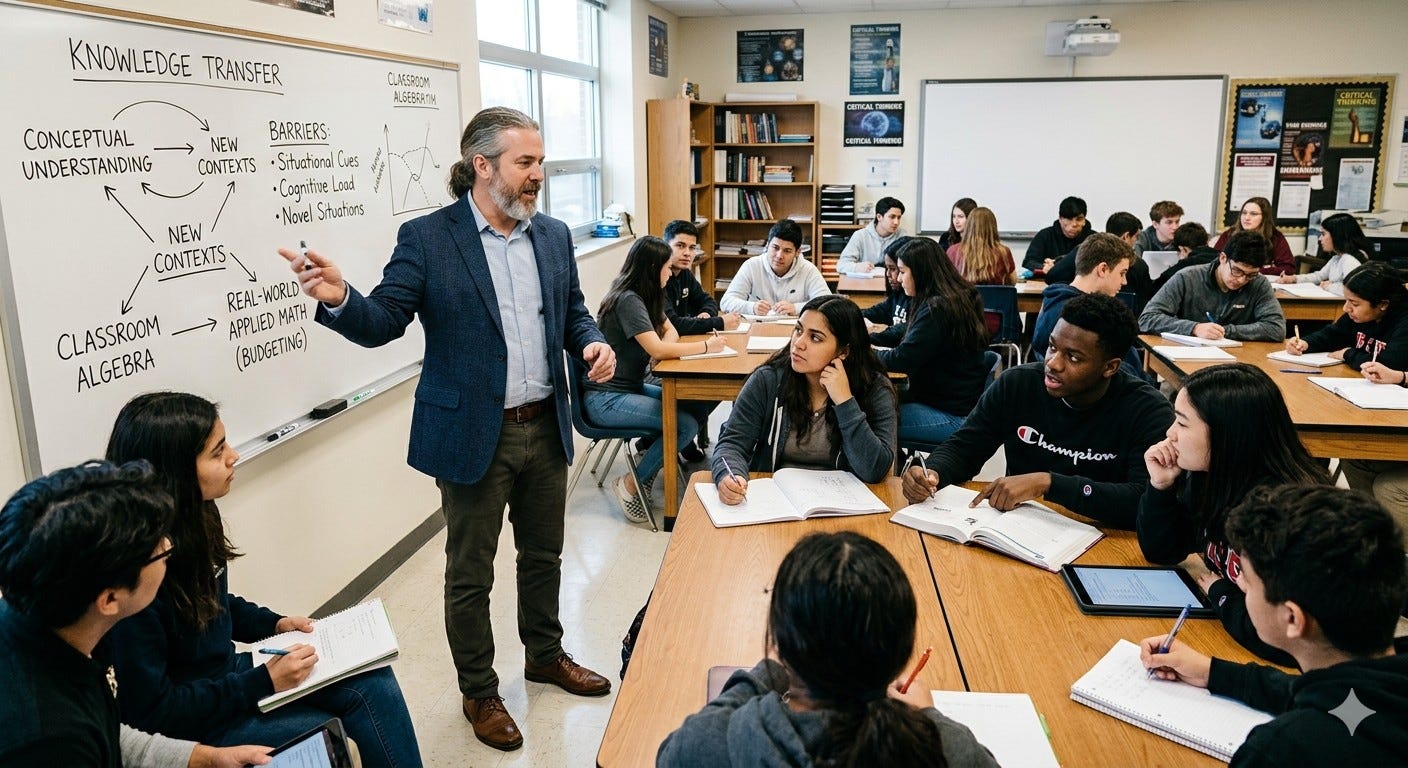
Experience shows that understanding is often more situational than learners realize. Students who solve algebraic equations with accuracy in class frequently falter when those same relationships appear in a budgeting problem or scientific model. The mathematics has not disappeared. The problem lies in recognizing when the knowledge applies. Transfer requires noticing deep structural similarities between situations, and that skill develops slowly. Novices focus on surface features such as wording, context, or presentation. Without extensive experience, they do not readily see past those features to the underlying principle.
Another barrier lies in how learning goals are communicated. Instruction often emphasizes correctness within a narrow task rather than flexibility across tasks. Students learn what to do to succeed in the immediate environment. They learn how to write the essay the teacher expects, how to answer the question in the format required, how to perform for the test. These behaviors lead to short-term success while reinforcing the idea that knowledge belongs to a specific setting. When expectations shift, learners feel unprepared because the rules they internalized no longer apply.
Cognitive load also plays a role. Applying knowledge in a new context demands more mental effort than recalling it in a familiar one. The learner must interpret the new situation, decide which prior knowledge is relevant, and adapt it to fit. Each step consumes attention. When working memory is overloaded, even well-learned ideas remain inaccessible. This explains why transfer often fails under pressure, in real-world settings, or when problems lack clear guidance.
Emotional factors further complicate transfer. Confidence tends to be context-dependent. A student who feels competent in the classroom may doubt their ability in a workplace or public setting. That doubt interferes with retrieval and application. Knowledge does not operate independently of identity and experience. Learners who see themselves as capable only in certain environments limit the situations in which they attempt to use what they know.
The difficulty of transfer does not mean learning is ineffective. It means learning requires deliberate design that goes beyond exposure and practice. Knowledge becomes transferable through varied experiences, reflection, and opportunities to apply ideas in multiple contexts. Learners need to see concepts used in different forms and settings, and they need guidance in identifying what stays constant across situations. Transfer improves when instruction highlights underlying principles rather than isolated tasks.
Applying what is learned in a new context is challenging because learning is shaped by context at every stage. Knowledge develops alongside the environments in which it is used, and separating the two requires time, experience, and intentional effort. Recognizing this difficulty leads to more realistic expectations about learning and more effective approaches to teaching. Transfer is not automatic. It is a skill that must be cultivated with the same care as the knowledge itself.