

Reading comprehension improves when students are taught to notice what is happening in their own minds as they read. The Thoughts, Questions, Epiphanies system, often shortened to TQE, does exactly that. It gives students a simple structure for tracking meaning as it develops, breaks the illusion that comprehension is passive, and trains readers to interact with text in disciplined, repeatable ways. In real classrooms with real students, TQE consistently pushes reading from surface level decoding toward genuine understanding.
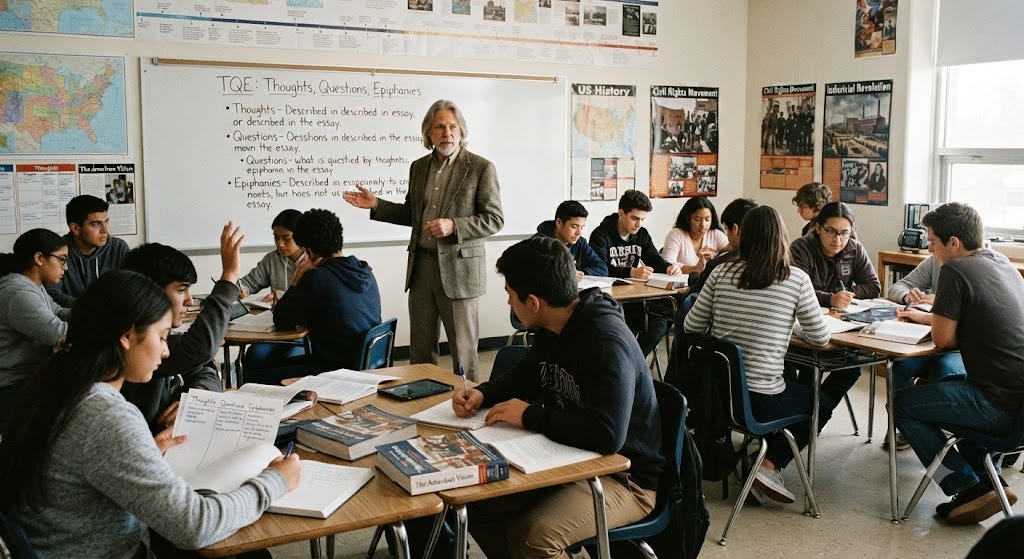
At its core, TQE asks students to sort their thinking into three categories. Thoughts capture observations, connections, and reactions. Questions identify confusion, curiosity, or uncertainty. Epiphanies mark moments when something clicks, an insight forms, or a previous idea sharpens. These categories mirror how experienced readers actually think. Strong readers notice patterns, pause when meaning slips, and feel recognition when ideas fall into place. TQE makes those invisible processes visible and teachable. One reason TQE improves comprehension is that it slows students down in productive ways. Many students read to finish rather than to understand. They move their eyes across the page, reach the end, and assume comprehension happened somewhere along the way. TQE disrupts that habit. When students are expected to record thoughts, questions, and epiphanies, they have a reason to pause. Pausing gives the brain time to process ideas instead of racing past them. This is not busywork. It is cognitive pacing. Students learn that meaning develops through attention.
TQE also reframes confusion as part of reading rather than a sign of failure. Students often believe that good readers understand everything immediately. When confusion appears, they assume something is wrong with them. The Questions component of TQE challenges that belief. Questions are not errors to hide. They are evidence of engagement. When students are invited to write down what they do not understand, they become more willing to wrestle with difficult passages. Over time, this reduces avoidance and builds stamina for complex texts. The system also helps students distinguish between shallow and deep understanding. A student who finishes reading may feel confident, though that confidence often rests on plot recall or isolated facts. TQE requires students to articulate thinking in their own words. Writing a thought forces a student to decide what matters. Writing a question reveals gaps in understanding. Writing an epiphany requires synthesis. These actions expose comprehension levels honestly. Students start to recognize the difference between recognizing words and constructing meaning.
Another strength of TQE lies in how it supports memory and retention. Comprehension improves when new information connects to existing knowledge. Thoughts often include personal connections, prior learning, or thematic observations. These connections anchor new ideas in memory. Epiphanies, in particular, tend to stick. When a student realizes how a character’s motivation explains earlier behavior or how an argument builds across paragraphs, that realization becomes memorable because it emerged through effort. TQE creates conditions for those moments to occur. TQE also improves classroom discussion in practical ways. When students arrive with written thoughts, questions, and epiphanies, discussion shifts from guessing what the teacher wants to sharing authentic thinking. Questions drive inquiry. Thoughts provide evidence from the text. Epiphanies give shape to larger insights. Participation broadens because students are no longer required to produce polished answers on the spot. They already have material worth sharing. This changes the social dynamics of reading discussions and raises the overall level of discourse.
From a teacher’s perspective, TQE offers clear diagnostic value. Looking at a student’s TQE notes reveals how that student is reading. A page filled only with surface level thoughts suggests limited engagement. A page dominated by questions may indicate decoding or vocabulary struggles. A lack of epiphanies signals that synthesis is not yet happening. This information allows targeted feedback and instruction. Teachers can respond to real thinking rather than guessing based on test scores or participation patterns. TQE also builds metacognition, which is a key driver of long-term comprehension growth. Students who understand how they think while reading gain control over that thinking. They start to notice when attention drifts. They recognize when confusion appears. They learn to reread strategically. These habits extend beyond a single assignment. Over time, students internalize the TQE framework and apply it without prompts. Reading becomes an active process guided by awareness rather than luck.
Critically, TQE works across disciplines. In literature, students track character development and theme. In history, they note cause and effect, bias, and perspective. In science, they question processes and clarify conceptual relationships. The system adapts because it is grounded in thinking, not content. This makes it especially valuable for secondary students who encounter dense texts in every subject. Some instructional strategies promise engagement without delivering understanding. TQE succeeds because it aligns with how comprehension actually develops. It respects the complexity of reading while giving students manageable tools. It treats thinking as something to be practiced, named, and refined. Students who use TQE read with purpose. They notice more. They question more. They understand more.
In classrooms that value real comprehension, TQE becomes more than a strategy. It becomes a shared language for thinking. That shared language changes how students approach text, how teachers respond to student work, and how reading is understood as an active, effortful, and rewarding process.