
Why Does Academic Success Depend on Managing One’s Own Learning?
Metacognition as the engine of independence and resilience

Metacognition stands among the strongest predictors of academic success because it governs how learners plan, monitor, and adjust their thinking. Content knowledge matters, effort matters, and instructional quality matters, yet students who consistently succeed across subjects share a quieter advantage. They understand how they learn, recognize when their understanding falters, and know what to do when it does. This awareness turns learning from a passive experience into an intentional process, one that adapts to new demands rather than collapsing under them.

Academic work rewards more than recall. It demands interpretation, synthesis, and judgment. Students face complex texts, multi-step problems, and open-ended tasks that do not announce their own solutions. Metacognition equips learners to navigate these demands by helping them ask productive questions of themselves. What is this task asking? What do I already know that applies here? What part is confusing, and why? Students who ask these questions early avoid common pitfalls such as misreading instructions, applying the wrong strategy, or persisting with ineffective approaches out of habit.
Research and classroom experience show that struggling students often invest significant time in studying while seeing limited results. The problem lies in how that time is used. Many learners mistake familiarity for understanding. They reread notes, highlight text, or review examples without checking whether they could reproduce the ideas independently. Metacognitive learners recognize this illusion. They test themselves, explain ideas in their own words, and notice gaps before those gaps become failures on assessments. This self-monitoring leads to more efficient studying and stronger retention.
Metacognition also supports persistence. Academic setbacks are inevitable, especially as students encounter more demanding material. Learners without metacognitive skills tend to interpret difficulty as a signal of inability. Those with stronger metacognitive awareness interpret difficulty as information. They adjust strategies, seek clarification, or allocate time differently. This shift in interpretation protects motivation and encourages productive struggle rather than avoidance.
Another reason metacognition predicts success lies in its transferability. Content knowledge remains tied to specific subjects, while metacognitive skills apply across disciplines. A student who learns to plan an approach to a history essay can apply the same planning habits to a lab report or a math problem set. Monitoring comprehension during a science reading strengthens monitoring during a philosophical text. This flexibility allows learners to adapt as academic demands change, which explains why metacognition becomes even more important at higher levels of education.
Developing metacognition does not occur automatically. It requires explicit practice and reinforcement. One effective strategy involves structured planning before tasks begin. Students benefit from taking a few minutes to articulate goals, anticipate challenges, and select strategies. Writing a brief plan before starting an assignment externalizes thinking and creates a reference point for later reflection. Over time, this habit becomes internalized.
Self-questioning during learning further strengthens metacognition. Questions such as “Do I understand this well enough to explain it?” or “What evidence supports this conclusion?” prompt learners to monitor comprehension in real time. These questions interrupt passive engagement and encourage active processing. Teachers who model this questioning during instruction help students see how experts think through problems.
Reflection after tasks plays an equally important role. Many students finish an assignment and move on without considering what worked or what did not. Guided reflection asks learners to evaluate their strategies, identify errors in thinking, and consider adjustments for future tasks. Short reflections, when done consistently, accumulate into meaningful insight about personal learning patterns.
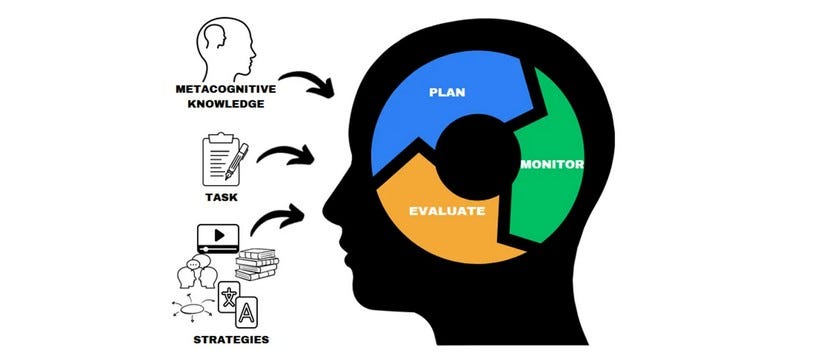
Metacognition: A catalyst for Reflection
Feedback amplifies metacognitive growth when it focuses on processes rather than outcomes alone. Comments that highlight effective strategies or point out mismatches between effort and results help students connect actions to consequences. This connection strengthens self-regulation and encourages deliberate change rather than blind repetition.
Metacognition thrives in environments where struggle is normalized and thinking is visible. Classrooms that invite students to explain reasoning, compare approaches, and revise work communicate that learning involves ongoing adjustment. In these settings, students learn to view confusion as a starting point rather than a failure.
Academic success depends on more than intelligence or compliance. It depends on the ability to manage one’s own learning in the face of complexity, uncertainty, and increasing independence. Metacognition provides that management system. It guides attention, shapes effort, and supports resilience. Students who develop metacognitive habits gain control over their learning rather than relying on external direction. This control explains why metacognition predicts success so reliably. It does not replace content knowledge. It determines how effectively that knowledge is acquired, used, and expanded over time.